

ublished: hongzhonglighting | Category: Smart Lighting, Energy Saving, Home Automation | Tag: Photocell, Timer Light, Motion Sensor, Low Power Lighting
Are you tired of high electricity bills caused by lights that stay on unnecessarily all day or night? Or tired of manually turning lights on and off every single day?
Smart lighting control systems solve these pain points perfectly. However, most homeowners and facility managers easily confuse light control (photocell sensor), time control (timer), and motion sensor (motion detection) and don’t know which one saves the most energy.
In this beginner-friendly guide, we explain these three smart lighting controls in plain English and break down the most energy-efficient combinations for homes, yards, stairwells, parking lots, and commercial buildings.
1. What Are The 3 Common Smart Lighting Controls?
We skip complex technical jargon. Below is a simple, practical explanation of each control type, including real-world advantages and disadvantages.
✅ Light Control (Photocell / Daylight Sensor)
Core logic: Auto ON/OFF based on brightness
A photocell sensor detects surrounding natural brightness. It keeps lights off during bright daylight and automatically turns lights on at dusk when the environment turns dark.
Best for: Street lights, garden lights, outdoor wall lamps
Pros:
- Zero manual operation
- No daytime electricity waste
- Works every day regardless of seasons or weather
Cons:
- Lights remain on all night even with no people or activity nearby
- Still causes unnecessary power consumption
[Image 1 Insert: Photocell Working Diagram]
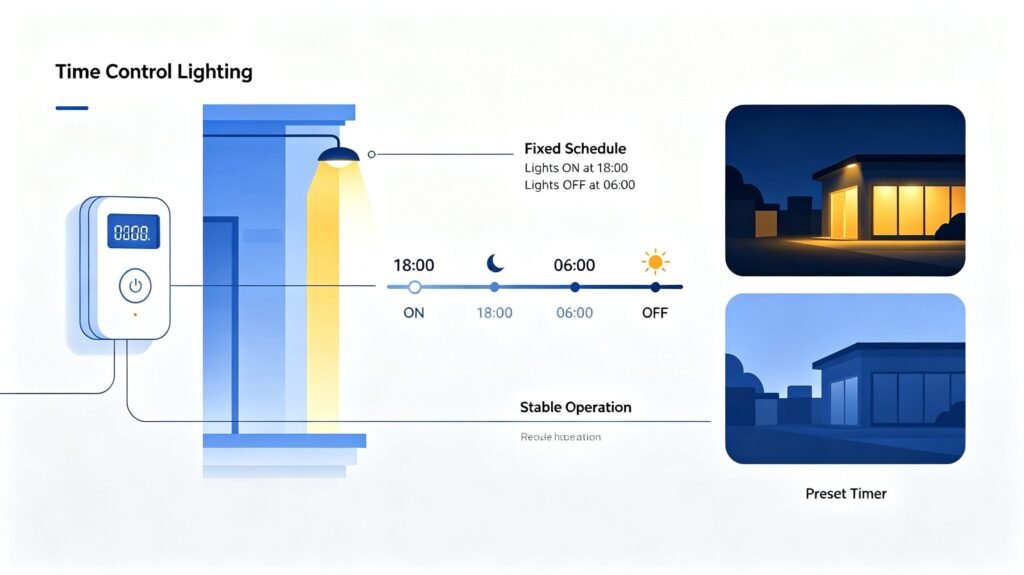
✅ Time Control (Timer)
Core logic: Auto ON/OFF based on fixed time
You set a fixed on/off schedule (for example: turn on at 6 PM, turn off at 6 AM). The lights follow your preset timetable strictly, regardless of sunny, cloudy, or rainy weather conditions.
Best for: Corridor lights, storefront lights, landscape lighting
Pros:
- Stable and predictable working hours
- Great for standardized building lighting management
- Easy to set and maintain
Cons:
- Cannot auto-adjust for seasonal daylight changes (longer/shorter days)
- Wastes energy when lights are on but unused
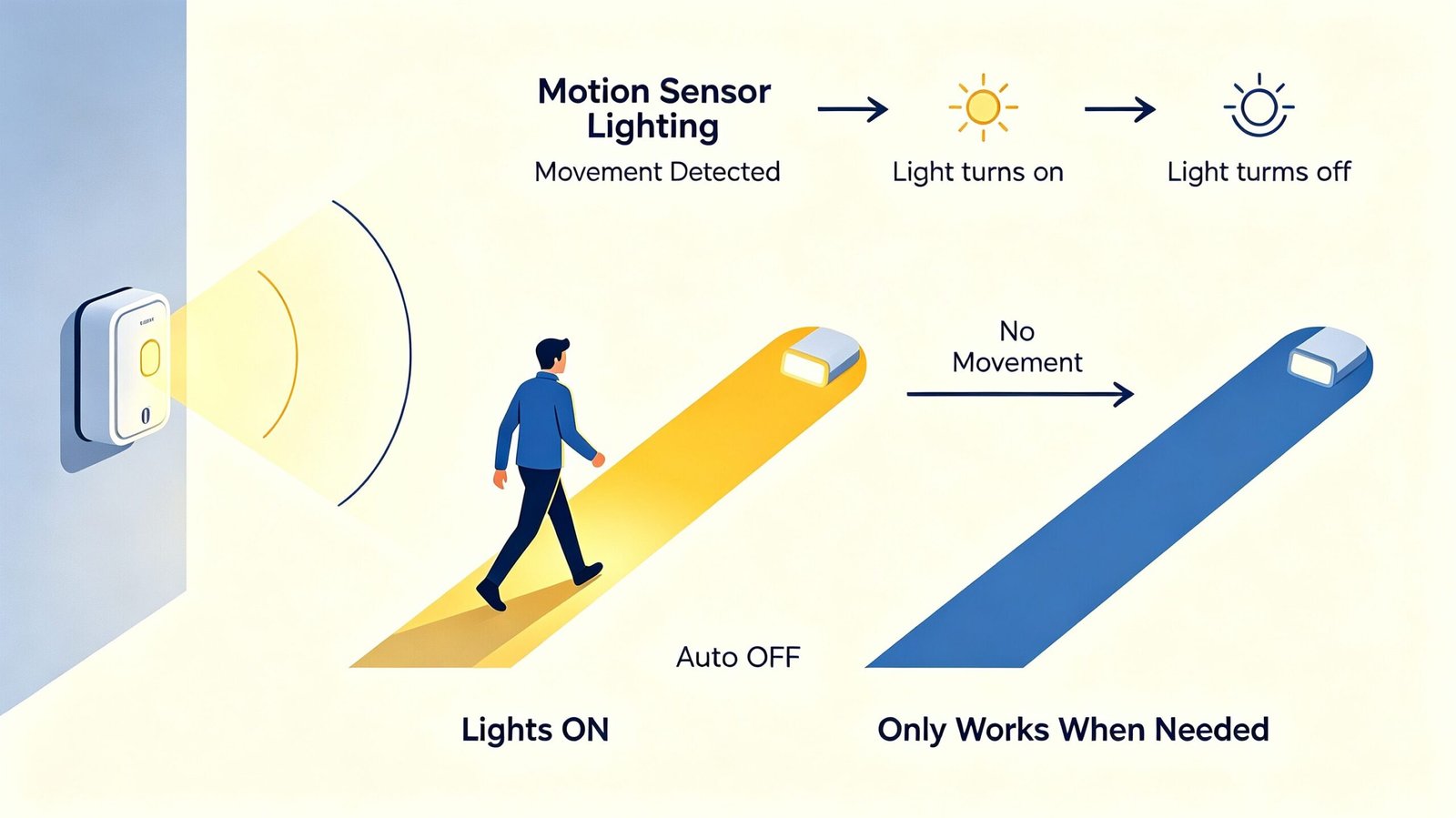
✅ Motion Sensor (Motion Detection / PIR Sensor)
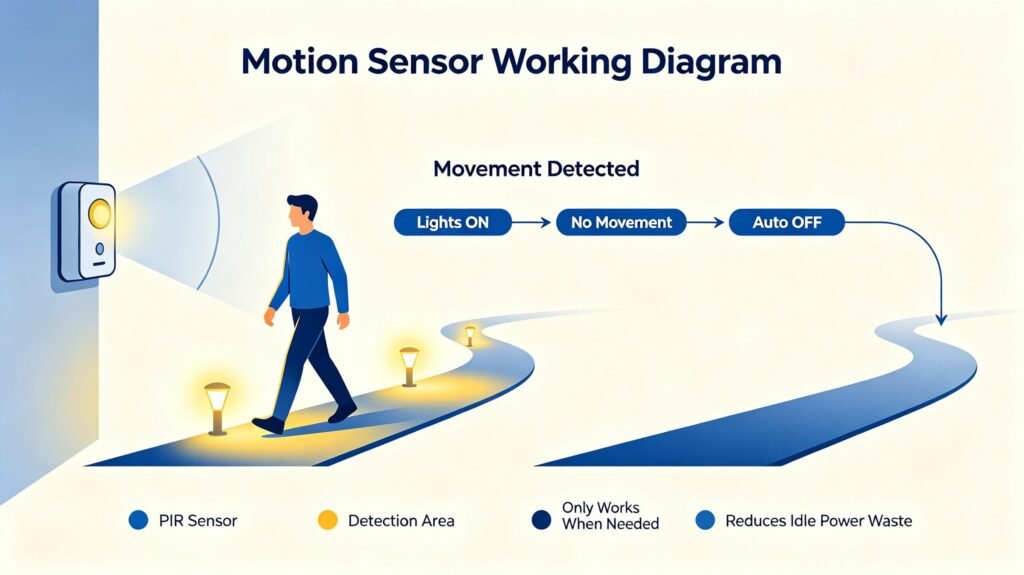
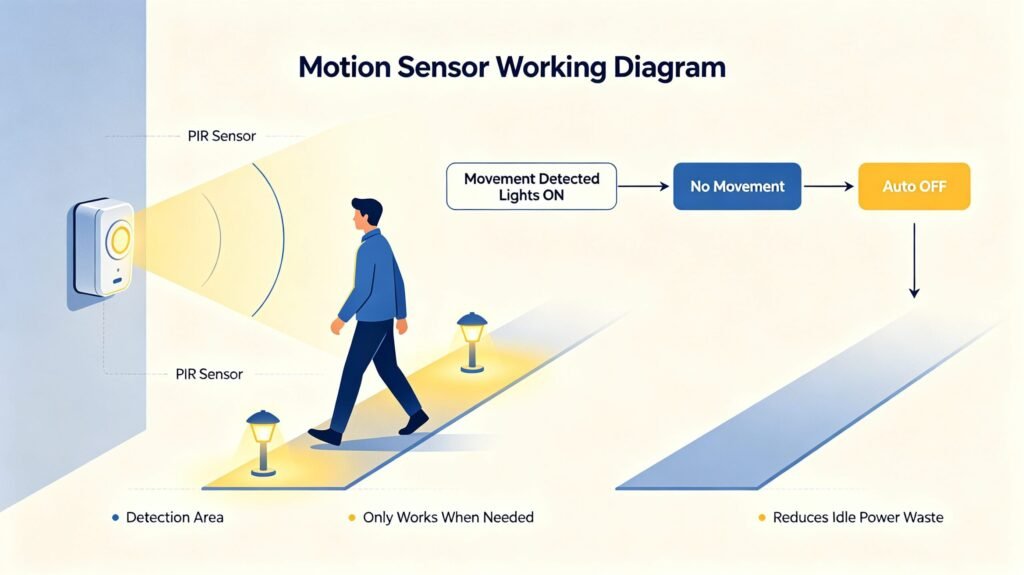
Core logic: Auto ON with movement, Auto OFF with no movement
PIR or microwave motion sensors detect human and vehicle movement. Lights activate immediately when motion is detected and automatically shut off after a custom idle delay to avoid wasted power.
Best for: Stairwells, garages, basements, backyard paths, storage rooms
Pros:
- Extreme energy saving — lights only work when needed
- Touch-free and super convenient
- Extends LED light lifespan by reducing working hours
Cons:
- Standalone motion sensors work 24/7 and may trigger falsely in bright daylight
2. Why Single Control Mode Is Never The Most Efficient
Many people use only one single lighting control mode but still face high electricity bills. Here is why standalone modes waste energy:
- Only light control: Lights stay on all night, huge idle power waste
- Only time control: Rigid schedule, cannot adapt to environment changes
- Only motion sensor: May activate in daytime and cause invalid power consumption
Final Takeaway: Single-control setups are simple but not energy-smart. Combined control systems deliver maximum energy savings and zero daily maintenance.
3. The Best Power-Saving Combination (100% Practical)
🏆 Ultimate Combo: Light Control + Motion Sensor (Most Recommended)
This is the most cost-effective, user-friendly gold-standard combo for residential and light commercial smart lighting.
Working rules (super simple):
- Daytime (bright): Light sensor locks the system. Lights stay OFF, even if motion is detected.
- Nighttime (dark): System enters standby mode. Lights turn ON only when people or vehicles pass by.
- No movement: Lights auto-off after preset delay, no all-night idle operation.
Energy Saving Performance: This dual-control setup cuts lighting power consumption by 40%–70% compared with traditional always-on night lights.
Perfect application scenarios: Yard lights, pathway lights, garage lights, stairwell lights, campus and community public lighting.
🥈 Advanced Combo: Light Control + Time Control + Motion Sensor
This triple-control solution is designed for high-standard commercial and public lighting, including parking lots, industrial parks, and large villa courtyards that require strict management rules.
Working logic:
- Light sensor: Forbid daytime lighting
- Timer: Restrict valid working periods (e.g., only active from 19:00 to 05:00)
- Motion sensor: Trigger lights on demand in valid periods
This triple combination eliminates almost all invalid power consumption and achieves 100% unattended intelligent lighting management.
4. Quick Scenario Matching Guide (Choose Your Mode)
| Scenario | Best Control Combination | Core Benefit |
|---|---|---|
| Home Yard & Garden | Light + Motion Sensor | Auto night activation, no daytime false trigger |
| Stairwell & Corridor | Light + Motion Sensor | Light on when passing, off when leaving |
| Street & Community Lighting | Light + Time + Motion Sensor | Standardized management + maximum energy saving |
| Storefront Decoration Lights | Light + Time Control | Stable display timing, simple management |
5. 2 Core Benefits You Cannot Ignore
💡 1. Dramatically Lower Electricity Bills
Traditional lighting wastes tons of electricity on unnecessary idle operation. Smart combined control systems ensure lights only work when needed. Long-term operation greatly reduces monthly electricity costs for both families and commercial properties.
💡 2. Zero Daily Management Work
No daily manual switching, no frequent timing adjustments, and no seasonal reset work. Once properly installed and configured, the system runs stably all year round, drastically lowering daily maintenance workload.
Final Verdict
If you want simple installation, low cost, and the best energy-saving performance for most scenarios:
Stick to Light Control + Motion Sensor — it fits 90% of lighting scenarios and balances energy saving and convenience perfectly.
For commercial facilities, public areas, and projects requiring standardized management, upgrade to the three-in-one light + time + motion sensor control system for full optimization.
FAQ
Q: Will motion sensors trigger on windy days or with moving animals?
A: Modern PIR motion sensors mainly detect human body heat and targeted movement. They effectively avoid false triggers caused by wind, moving leaves, rain, or small pets.
Q: Does combined control affect light service life?
A: It actually protects your lights. Reducing long-time continuous lighting lowers heat accumulation and light decay, greatly extending LED lamp service life.
Did you find this smart lighting guide helpful? Save power, cut bills, and simplify your lighting management — share this post with your family, friends, and property managers!